



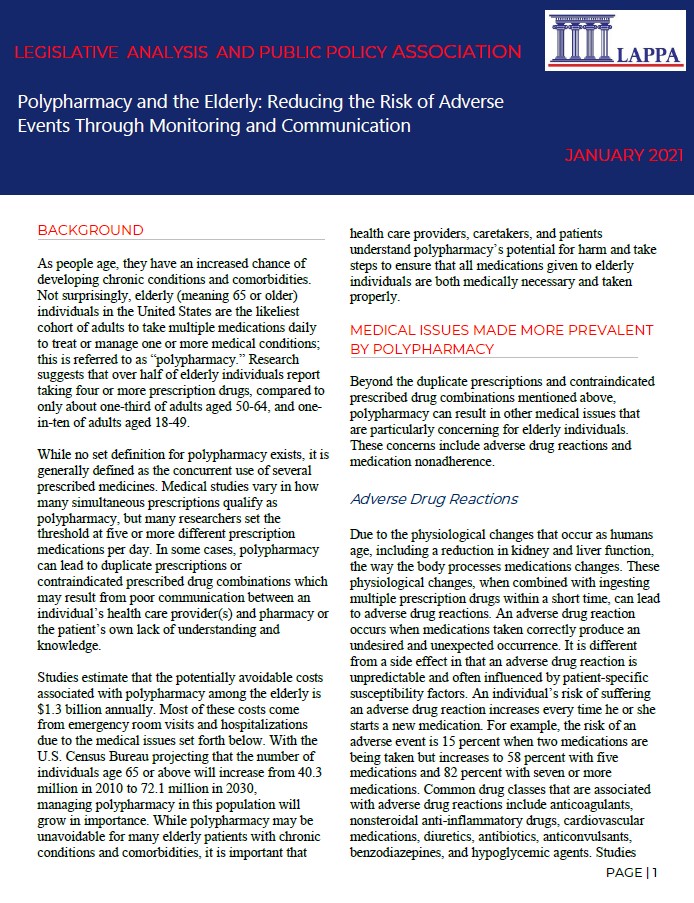
Polypharmacy and the Elderly: Reducing the Risk of Adverse Events Through Monitoring the Communication – a FACT SHEET by the Legislative Analysis and Public Policy Association
While no set definition for polypharmacy exists, it is generally defined as the concurrent use of several prescribed medicines. Medical studies vary in how many simultaneous prescriptions qualify as polypharmacy, but many researchers set the threshold at five or more different prescription medications per day. In some cases, polypharmacy can lead to duplicate prescriptions or contraindicated prescribed drug combinations which may result from poor communication between an individual’s health care provider(s) and pharmacy or the patient’s own lack of understanding and knowledge. As people age, they have an increased chance of developing chronic conditions and comorbidities. Not surprisingly, elderly individuals in the United States are the likeliest cohort of adults to take multiple medications daily to treat or manage one or more medical conditions; this is referred to as “polypharmacy.” Research suggests that over half of elderly individuals report taking four or more prescription drugs, compared to only about one-third of adults aged 50-64, and one-in-ten of adults aged 18-49. This fact sheet provides information about Polypharmacy, which can have many serious adverse effects, particularly in the elderly population.
Read the Fact Sheet.